
About a century ago, chemists began tinkering with substituted benzaldehydes. The search was grounded in curiosity about aromatic ring chemistry. As each new methoxy group was added, lab notebooks filled with observations. By the 1950s, the synthesis and use of 2,3,4-Trimethoxybenzaldehyde gained traction. Research groups noticed that swapping out different functional groups on a benzene ring changed reactivity in big ways. Its preparation became a mainstay in academic labs, not because it was exotic, but because it taught useful lessons about electron-rich aromatic systems and how they interact with various reagents.
2,3,4-Trimethoxybenzaldehyde belongs to a broader family of substituted aromatic aldehydes. Three methoxy groups fill out the ring, each pulling their weight in shaping the molecule’s electron distribution. The aldehyde group adds the familiar bite for chemical reactions. This compound is not flashy, but it offers reliability, tailor-made for roles as an intermediate in organic synthesis. Everyday chemical industries, from pharmaceuticals to fragrance makers, keep their eyes open for compounds like this—not for the limelight, but for steady, predictable outcomes.
This compound generally appears as pale solid crystals, making it easy to spot and handle in the lab. With a melting point around the lower end of the spectrum for aromatic aldehydes—about 70–75°C—one can purify it without jumping through hoops. Its faint, sweet odor signals the aldehyde function, but the real interest comes from high solubility in organic solvents like dichloromethane and ethyl acetate. The structure keeps it from dissolving well in water. The three methoxy groups on the aryl ring push electrons toward the aldehyde group, shifting both the physical behavior and the chemical reactivity. The electron-rich ring resists some oxidizers, but welcomes nucleophiles at specific positions.
Chemical suppliers rely on tight technical specs for a batch of 2,3,4-Trimethoxybenzaldehyde. Purity sits at the top—analytical grades often hit above 98%. GC or HPLC profiles guard against side-products. Moisture content gets checked, since water can spoil critical reactions. CAS number, structural formula, and proper hazard statements get stamped on every container, keeping the workflow safe and well-documented. Product data sheets detail batch numbers, lot certifications, and contamination checks. Chemists lean on this info, having seen what happens when a mislabeled aldehyde throws off a reaction series.
There’s an old-school satisfaction in synthesizing 2,3,4-Trimethoxybenzaldehyde from scratch. The typical approach starts with 2,3,4-trimethoxytoluene, a compound accessible from methylation of corresponding hydroxy derivatives. Oxidizing agents like chromyl chloride, potassium permanganate, or manganese dioxide nudge the methyl group over to an aldehyde. Some routes shave reaction time by deploying metal-catalyzed oxidation, cutting down on side products and waste. Afterward, extraction, washing, drying with anhydrous salts, and crystallization tidy up the product. This is the sort of routine that builds muscle memory for generations of students and researchers.
The real utility of this compound comes out in its participation in reactions like the Knoevenagel condensation and the Wittig reaction, where the aldehyde carbonyl meets a range of reactants. The methoxy groups pump up electron density, tuning reactivity compared to benzaldehyde. That makes some substitutions tricky—direct halogenation, for example, pushes back—but the electron-rich ring eagerly entertains cross-coupling and ether cleavage under specific conditions. Reduction gives 2,3,4-trimethoxybenzyl alcohol, which opens up even more downstream chemistry. Amid all these transformations, the three methoxy groups help stabilize intermediates, helping with yields in the lab, which any chemist can appreciate.
People might hear 2,3,4-Trimethoxybenzaldehyde referred to by a range of names depending on the supplier or the research context. Trimethoxybenzaldehyde, 2,3,4-TMBA, 2,3,4-TriMethoxy-benzaldehyde, or by its registry number. These aliases keep the paperwork confusing sometimes. That’s why most chemists always double-check the structure or run a spectral comparison before launching into a synthetic sequence.
Handling this compound calls for common-sense safety and a nod to its chemical quirks. Aldehydes have a tendency to irritate the skin and nose—a whiff can trigger sneezing, and repeated exposure gets uncomfortable. Laboratories require gloves, eye protection, and good ventilation. Material safety data sheets flag fire risks and incompatibility with strong oxidizers and reducing agents. Disposal practices avoid pouring leftover aldehyde down the drain, since it can affect aquatic life. Waste solvents gather in dedicated containers, and finished reactions get worked up in ways that minimize exposure and environmental impact. Adhering to local regulations isn’t just bureaucratic; it protects lab workers and the community.
The influence of 2,3,4-Trimethoxybenzaldehyde spreads through several industries. In medicinal chemistry, it forms a backbone for synthesizing tetrahydroisoquinoline derivatives, a family that researchers keep probing for anticancer and neurological activity. Fragrance producers reach for related aldehydes to round out perfumes and incense blends—methoxy substituents offer nuanced olfactory notes. Agrochemical labs test analogs for plant growth regulation and pest control. It’s clear that this molecule’s adaptability stretches across sector boundaries, making it an underappreciated enabler in the background of product development.
Academic projects continue digging into its unique reactivity, often using it as a model substrate for new synthetic methodologies. Teams in various universities run comparative trials, swapping in different substituents to see what shifts in biological activity or chemical behavior. The structure also gets pressed into service for spectroscopic calibration and as a teaching tool in organic chemistry labs. Its predictable results offer a reliable way to validate new catalysts and reaction conditions, providing solid data for anyone pushing the frontiers of aromatic synthesis.
Toxicity profiles for 2,3,4-Trimethoxybenzaldehyde highlight the expected irritancy of aromatic aldehydes. Research groups have tracked acute oral and dermal exposures, noting a low risk of severe poisoning under standard lab practice, but long-term studies stay thin. Animal studies flag mild organ effects at high doses, mostly tied to reactive intermediates formed during metabolism. Chronic exposure in manufacturing settings gets special scrutiny, with recommendations for air monitoring and medical screening. So far, the compound’s track record suggests relatively low environmental risk so long as disposal stays responsible and contact stays limited.
Interest in 2,3,4-Trimethoxybenzaldehyde won’t fade any time soon. Pharmaceutical researchers push further into drug discovery, using the compound for scaffold hopping and SAR studies. Improvements in green chemistry may offer cleaner synthetic routes and less hazardous waste, allowing for wider adoption in scale-up environments. Analytical chemists continue to use it as a probe for machinery calibration and structure-activity exploration. As new industries look for unique aromatic scaffolds for advanced materials and specialty chemicals, this classic intermediate keeps finding its place. Cheaper, safer production methods and enhanced toxicological profiling look set to enhance its reputation further, securing its space in both lab-scale and industrial toolkits.
2,3,4-Trimethoxybenzaldehyde stands as a meaningful compound in organic chemistry, both in labs and in the fine chemical industries. Its molecular formula is C10H12O4. This structure consists of a benzene ring adorned with three methoxy (-OCH3) groups at positions 2, 3, and 4, and an aldehyde (-CHO) group at position 1. The arrangement looks simple on paper, but its design gives it a unique set of properties that researchers use to build new molecules.
The three methoxy groups lend the benzene ring strong electron-donating power, which changes how the molecule behaves during chemical reactions. In my experience working with aromatic compounds, electron-donating groups at these specific locations make the ring much more reactive in many synthetic transformations. This alteration boosts yields and opens up pathways for compounds not easily accessible from plain benzaldehyde. For example, in pharmaceuticals, these groups can nudge the molecule toward new bioactivities, helping scientists craft potential medicines.
The aldehyde group is another important player. It reacts with a wide range of nucleophiles, which means 2,3,4-Trimethoxybenzaldehyde can serve as a starting block for building larger molecules. The reactivity granted by the three methoxy groups often lets chemists use milder conditions for important steps, saving energy and reducing waste. It’s common sense—small tweaks to chemical structure often lead to big shifts in what you can do with a molecule. Here, that’s exactly the case.
I've worked on projects where this compound’s structure made a world of difference. In the synthesis of certain natural products or pharmacologically active compounds, 2,3,4-Trimethoxybenzaldehyde acted as an essential intermediate. Because the methoxy groups protect the benzene ring from harsh reactions, they let multi-step syntheses proceed without unwanted side-effects like ring oxidation or demethylation. That reduces the need for excess purification and cuts costs over time.
To see a practical example, the compound has seen use in the synthesis of tetrodotoxin analogs and some neurological agents. The electron-rich environment created by the methoxy groups supports complex rearrangements needed for building up such intricate skeletons. Plus, researchers see it as a stepping stone for creating heterocycles and benzofurans, classes of compounds that underpin many patent-protected drugs.
No discussion about chemicals in research or industry feels complete without thinking about trust and safety. High-purity 2,3,4-Trimethoxybenzaldehyde comes from established suppliers following Good Manufacturing Practice (GMP). Lab analysts often run NMR, IR, and mass spectrometry on each batch, making sure that not just the structure, but the actual sample matches what’s needed for precision experiments. Mistakes here could result in wasted efforts—or dangerous byproducts if used in further transformations.
One challenge in this field comes from scaling up production safely and affordably, as the reagents for introducing three methoxy groups aren’t always easy to handle on a larger scale. Regulatory agencies now ask suppliers for greater transparency about the steps, aiming to reduce environmental impacts and potential exposure risks. This move matches what experienced chemists want: reliable, green production methods that support progress without unnecessary waste.
Companies looking to stand out spend time researching solvent-free approaches or catalytic processes that speed up the creation of trimethoxybenzaldehyde, making results safer and more predictable. As science demands more sustainable options, chemists and producers need to rethink everyday synthesis routes. This sort of innovation keeps everyone safer, lowering both costs and environmental footprint.
Step into the world of fine chemicals and you’ll meet a cast of characters with names not exactly made for conversation. Take 2,3,4-Trimethoxybenzaldehyde as an example. Most people outside a lab have never heard of it, but this compound quietly powers a lot of innovation, particularly in pharmaceuticals, fragrance, agrochemicals, and academic chemistry.
Pharmaceutical research leans on building blocks like 2,3,4-Trimethoxybenzaldehyde to assemble more complex molecules. I’ve worked on early-stage drug development projects where finding the right aromatic aldehyde opens doors to unique molecules with possible therapeutic effects. This compound’s methoxy groups make it a flexible starting point for synthesizing various drugs. For example, some early cancer drug candidates have incorporated this structure. Lab teams like the electron-rich nature of the trimethoxy ring, since it helps steer reactions and fine-tune biological properties. Even some psychoactive compounds in the phenethylamine class have drawn on this chemical early in their synthesis. The pharmaceutical sector sees value in speed and reliability, and using this tried-and-true intermediate means fewer unwanted surprises during synthesis.
The way a fine fragrance grabs your attention owes just as much to chemistry as it does to an artist’s nose. In the world of scents and flavors, 2,3,4-Trimethoxybenzaldehyde forms the backbone of certain musky and floral notes. Natural sources might not always offer enough of a specific fragrance compound, so chemists opt for a reliable synthetic route beginning with trimethoxybenzaldehyde. Thanks to the methoxy substituents, the molecule gives perfumers neat entry points to craft complex scent profiles. From a regulatory perspective, synthetic production also helps meet high purity standards, lowering risks of allergens in a finished product.
Modern farming keeps finding new ways to grow more with less. This push means agrochemical researchers are always tweaking pesticide and herbicide formulations. 2,3,4-Trimethoxybenzaldehyde plays a role here too. Researchers shape it into bioactives that shield crops from pests or disease. It usually serves as an intermediate in forming fungicides and insecticides with specific activity. Through years of collaboration with agricultural chemists, I’ve seen how the flexibility of trimethoxybenzaldehyde’s structure helps researchers design molecules that are tough on pests but kinder to the environment than past generations of chemicals.
In the academic lab, 2,3,4-Trimethoxybenzaldehyde shows up in many teaching and research projects. Its reactivity and the resilience of its substituted aromatic ring make it a perfect candidate for exploring reaction mechanisms or creating new catalysts. Experimental chemistry professors often select this compound to illustrate fundamental organic reactions, like the famous Aldol condensation, to generations of budding scientists.
Demand for efficient and sustainable synthesis only keeps growing, both in pharmaceuticals and food technology. Using 2,3,4-trimethoxybenzaldehyde opens up more environmentally friendly options, since chemists can sculpt molecules with fewer steps and reduced waste. Working at the intersection of science and industry, I’ve seen the power of creative chemistry — and this compound has become a small but key part of much bigger stories in health, flavor, and innovation.
Digging into specialty chemicals sometimes feels like entering a maze. 2,3,4-Trimethoxybenzaldehyde is one of those building blocks you’ll spot in labs focused on pharmaceuticals and organic synthesis. With its aromatic aldehyde structure, it isn’t what you’d call wildly reactive. That doesn’t mean it’s innocent or can sit on just any lab shelf long term. Mishandling can cost time, money, and even safety.
Best results come from predictable storage. Oxygen, moisture, heat, and light all carry risks that slowly chip away at chemical stability. This compound prefers a cool, dry, tightly sealed spot. If you let humidity creep in, or temps swing up and down, the odds of oxidation or hydrolysis start to rise. Degraded raw material means poor results or failed reactions. Industry best practice for aldehydes like this one: keep it away from direct sunlight, store below room temperature, and always screw those lids on tight.
Plastic or glass bottles, amber in color, work well because they block UV light. Silica gel packets inside cabinets help control moisture. I’ve seen expensive drums go bad because they sat open while the air conditioning in the storage room broke down. It’s not even rare: temperature logs routinely show forgettable spikes leading to spoiled stocks. Local fire codes often set rules for flammable liquids and organics, so checking policies beats learning the hard way through a spill or a visit from safety inspectors.
No gloves, no goggles, no chemical fume hood? That’s how accidents happen—sometimes quietly, until a rash or persistent cough develops days later. Even less reactive aldehydes deserve respect. Inhalation or skin exposure can trigger irritation. Staff in the know never lean over an open jar. Instead, they weigh out doses in a fume hood, wearing chemical-resistant gloves and safety glasses. Small powder spills on benchtops may look harmless, but dust can become airborne and travel fast. Regular wipe-downs with ethanol keep benches safe to work on.
For years, professionals used old glass bottles with brittle stoppers and mysterious labels. Hard lessons from chemical burns and ruined projects have pushed modern labs to invest in new containers, proper labeling, and secure shelving. Routine training for new hires saves headaches and keeps productivity up. I’ve seen outcomes improve not by fancy automation, but by workers who respect every step in the chain—especially with intermediates like 2,3,4-Trimethoxybenzaldehyde.
Disposal rules for unused or spilled material follow local and federal law. Dumping it down the drain is both illegal and harmful. Instead, laboratories tag their waste in sealed, labeled containers until pickup. Outside contractors trained in hazardous chemical logistics handle the rest. On the one hand, it sounds like bureaucracy. On the other, no one wants traces of synthetic chemicals entering water supplies or soil.
Aldehyde handling depends on routine and respect—not just with fancy new compounds, but seasoned workhorses like 2,3,4-Trimethoxybenzaldehyde. Safe habits lead to reproducible experiments, trusted results, and fewer health problems. Instead of shortcuts, adopting careful storage and handling processes turns a risk into just another step of the day.
Working in a lab, I’ve come across a lot of chemicals that demand respect. 2,3,4-Trimethoxybenzaldehyde often pops up in organic synthesis and drug research. But every time this compound is on the table, a few real-world lessons come to mind about safety. This aromatic aldehyde won’t explode like some unstable reagents, but it doesn’t mean handling it should get casual.
On paper, this chemical seems unremarkable: solid at room temperature, a faint scent, and a powdery texture. OSHA and GHS data list it as an irritant. That might sound mild, but “irritant” covers a pretty wide range of trouble in regular use. Accidentally breathing the dust or splashing it on your skin turns uncomfortable fast—itching, redness, watery eyes. Even if you think you’re fine at first, reactions build over time.
It doesn’t take long to learn that the harm from chemicals like this isn’t just in the short term. Aldehydes have a reputation for playing rough with our bodies. Studies show repeated exposure can lead to sensitization—meaning, a person can go from irritation to a full-on allergic response after enough contact. Inhaling dust isn’t just unpleasant: those tiny particles can dig deep into the lungs. I once underestimated the airborne risk and spent hours coughing. It taught me that “low volatility” doesn’t mean “no risk.”
Lab work is all about habits—the right ones keep you safe. Gloves aren’t optional, even for quick tasks, because skin absorption happens fast with organics like this. Nitrile gloves stand up best here since latex tends to break down with aromatic chemicals. Lab coats, goggles, and a fume hood turn routine into second nature after a while. One rush job skipping goggles to save time leads to regrets that last days.
Mixing and transferring this powder always produces a bit of dust. That’s why weighing it happens in a fume hood or with proper local ventilation. Respirators matter if controls feel lacking or the hood isn’t pulling enough air. The CDC and NIOSH keep recommending similar setups. Getting complacent means inviting exposure—every spilled scoop on the balance reminds me why ventilation earns the budget it takes up.
The dangers don’t vanish outside active use. Storing this compound, I found cool, dry, sealed conditions make the difference. Moisture and heat degrade the product but also sometimes create more hazardous byproducts. Labels shouldn’t fade, and everyone working in the area needs real training—not just a warning sticker. Locking away the stuff from common-use shelves and marking it prevents surprise contact, especially for those new to the lab.
If something spills, dry powders get contained using damp cloths or inert material (like vermiculite), not by sweeping up dry. The goal is to keep dust from becoming airborne, not just to tidy up. Gloves go straight to the trash after cleanup—trying to get “just one more use” out of a used pair only spreads residue to the next thing you touch, including your own face.
Working with 2,3,4-trimethoxybenzaldehyde, or anything like it, isn’t about being afraid. It’s about seeing patterns—how regular exposure creates risk, how simple barriers save hours in first aid and health issues down the line. Investing in training, gear, and thoughtful storage pays off, not just for your own sake, but for everyone sharing the workspace. If just one set of eyes spots a risky situation or a shortcut before it becomes trouble, it proves the value of experience and caution over convenience.
I’ve spent years hunting for reliable chemical supplies in both academic and industrial labs. Quality doesn’t come cheap, and for something like 2,3,4-Trimethoxybenzaldehyde, buyers invest more in purity than in fancy packaging or marketing pitches. In the world of fine chemicals, it’s common to ask how pure the compound is, who made it, and what kind of certification backs up that number.
Most suppliers aim high and deliver this compound at 98% purity or higher. The better stock ships at 99% or even 99.5%. For a compound used in pharmaceutical or advanced organic synthesis, that margin matters. You’re not just looking for a pretty white powder — you’re betting projects, grants, and sometimes patient outcomes on those few decimal points. Impurities can trip up downstream reactions. I remember running a project where 97% grade just didn’t cut it; unknown contaminants showed up in our NMR spectra and almost set us back a month. Analytical labs confirmed the difference whenever we switched to 99+% material.
Pure isn’t enough. Chemical suppliers break down specs nut by nut: moisture content, melting point (usually close to 76-78°C for this compound), color, residue on evaporation, and spectral data. Analytical methods like NMR, HPLC, and GC confirm identity and purity. Some sources even publish detailed impurity profiles with their certificate of analysis (CoA). Any batch with aromatic or methoxy contamination raises a flag — nobody wants their results muddied by leftovers from incomplete synthesis or poor storage.
Buyers checking for 98% or 99% purity haven’t lost their minds; a single percent of unknowns can include persistent, reactive, or toxic byproducts. These hitchhikers can ruin entire product lines. For example, if you’re working on synthesizing bioactive molecules, a contaminant could mimic or mask the effect you’re trying to study. This isn’t just academic nitpicking — from a safety standpoint, anything unaccounted for means risk. I once saw a bad batch slip into an undergraduate teaching lab; it didn’t go well, and it took days to hunt down the source.
Top labs don’t settle. They work only with suppliers who provide batch-specific CoAs, fresh analytical data, and open channels for questions. Vendors without transparency lose business. This market pressure keeps standards high, but there’s always room for error. I’d push for stricter global standardization — sharing analytical results and using recognized methods (like adhering to ACS grade or ISO certifications). Small suppliers could step up by adopting more comprehensive analysis and clear documentation, which helps build trust for both old and new clients.
Labs should invest in regular incoming QC checks, not just rely on someone else’s paperwork. Running a thin-layer chromatography plate or NMR on arrival can catch surprises early. Encouraging vendors to earn third-party verification helps too. Not every lab has the budget for high-end analytics, so collaborations with established QC labs support this process. As demand for 2,3,4-Trimethoxybenzaldehyde grows in specialty and pharma sectors, the industry has a responsibility to raise (and maintain) its own bar. Customers ask for more than numbers; they want peace of mind backed by real data.
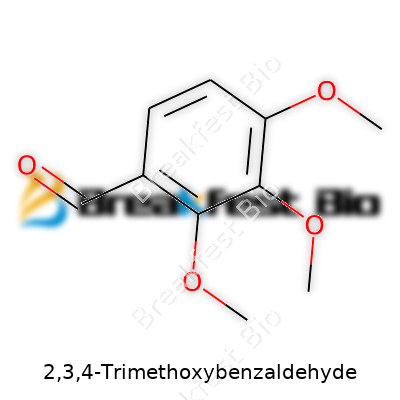
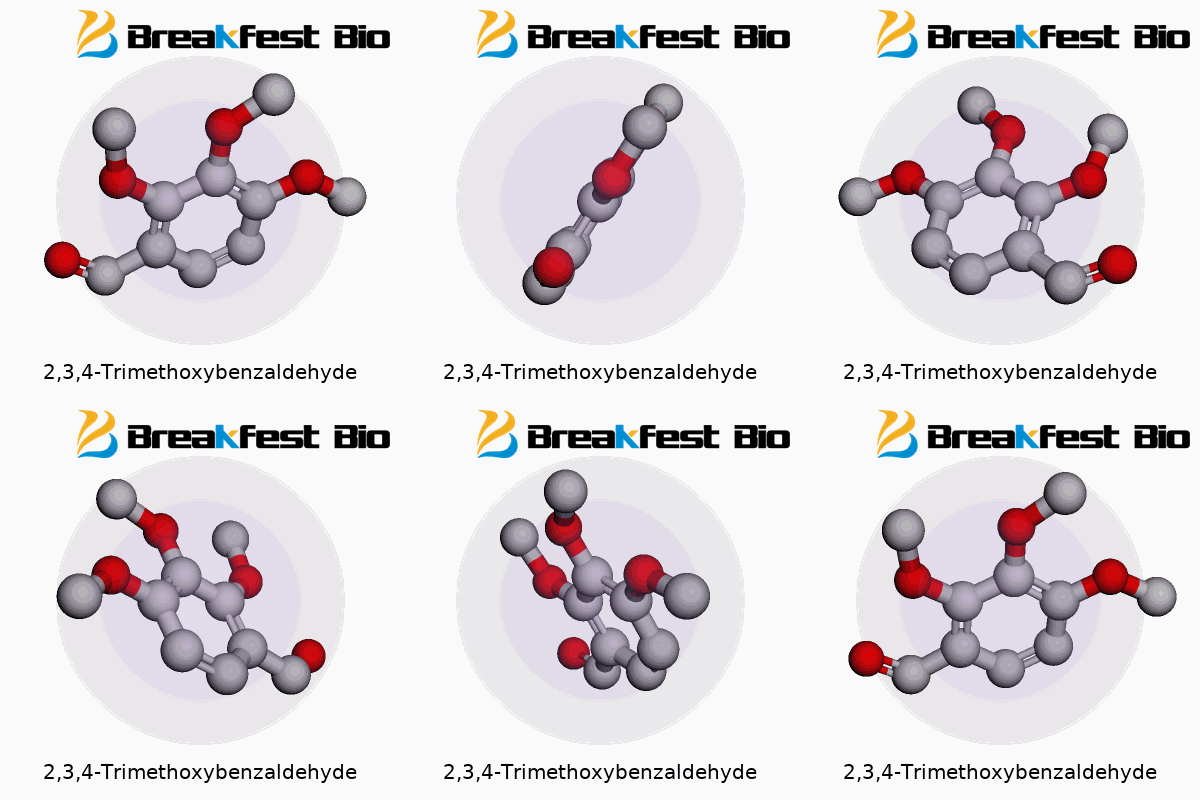
| Names | |
| Preferred IUPAC name | 2,3,4-Trimethoxybenzenecarbaldehyde |
| Other names |
Benzaldehyde, 2,3,4-trimethoxy-
2,3,4-Trimethoxybenzaldehyde 2,3,4-Trimethoxybenzenecarbaldehyde |
| Pronunciation | /tuː θriː fɔːr traɪˌmɛθ.ˈɒk.si.bɛnˈzæl.dɪ.haɪd/ |
| Identifiers | |
| CAS Number | 645-16-1 |
| Beilstein Reference | 1857176 |
| ChEBI | CHEBI:34719 |
| ChEMBL | CHEMBL226474 |
| ChemSpider | 157203 |
| DrugBank | DB04257 |
| ECHA InfoCard | 03e58d1a-0497-4b60-95f9-270f6ac5433a |
| EC Number | 2103-57-3 |
| Gmelin Reference | 79060 |
| KEGG | C06522 |
| MeSH | D015991 |
| PubChem CID | 3187 |
| RTECS number | DC3150000 |
| UNII | JK3J9N6S0O |
| UN number | 2811 |
| CompTox Dashboard (EPA) | DTXSID9044361 |
| Properties | |
| Chemical formula | C10H12O4 |
| Molar mass | 196.21 g/mol |
| Appearance | White to off-white solid |
| Odor | Odorless |
| Density | 1.17 g/cm³ |
| Solubility in water | slightly soluble |
| log P | 1.76 |
| Vapor pressure | 0.000102 mmHg at 25°C |
| Acidity (pKa) | 7.1 |
| Basicity (pKb) | 12.11 |
| Magnetic susceptibility (χ) | -61.5e-6 cm³/mol |
| Refractive index (nD) | 1.557 |
| Viscosity | 61 mPa·s (25 °C) |
| Dipole moment | 3.14 D |
| Thermochemistry | |
| Std molar entropy (S⦵298) | 332.6 J·mol⁻¹·K⁻¹ |
| Std enthalpy of formation (ΔfH⦵298) | -323.3 kJ/mol |
| Std enthalpy of combustion (ΔcH⦵298) | -1665.7 kJ/mol |
| Hazards | |
| Main hazards | Harmful if swallowed. Causes skin and serious eye irritation. May cause respiratory irritation. |
| GHS labelling | GHS07 |
| Pictograms | GHS07 |
| Signal word | Warning |
| Hazard statements | H302, H315, H319, H335 |
| Precautionary statements | P261, P264, P271, P272, P280, P302+P352, P321, P363, P333+P313, P362+P364, P501 |
| Flash point | 119°C |
| Autoignition temperature | Autoignition temperature: 410 °C |
| Lethal dose or concentration | Lethal dose or concentration: LD50 (oral, rat) > 2000 mg/kg |
| LD50 (median dose) | LD50 (median dose): Oral rat LD50 > 2000 mg/kg |
| NIOSH | DD1575000 |
| REL (Recommended) | 10 mg/m³ |
| Related compounds | |
| Related compounds |
Benzaldehyde
2,3,4-Trimethoxybenzoic acid 2,4,5-Trimethoxybenzaldehyde 3,4,5-Trimethoxybenzaldehyde 2,3,4-Trimethoxytoluene Vanillin Anisaldehyde |


